Folio 2 Due Tuesday, November 15
2.1 Figure in Geometric Space
2.2 Movement Drawing (craft)
2.3 In-class Interior
2.4 Homework: Figure in Interior
2.5 Mixed Media Figure
2.6 Multi-pose Figure (two drawings, color pencil)
2.7 Five Best Gestures
Good Luck!
Thursday, November 10, 2016
Tuesday, October 11, 2016
1043 - Drawing 2 - Folio 1
Due this Thursday, October 13:
1.1 Large Object Still Life
1.2 Museum Interior (22 x 30 Arches)
1.3 Campus Exterior (22 x 30 Arches)
1.4 Homework: Interior or Exterior of your choice
Good luck!
1.1 Large Object Still Life
1.2 Museum Interior (22 x 30 Arches)
1.3 Campus Exterior (22 x 30 Arches)
1.4 Homework: Interior or Exterior of your choice
Good luck!

Thursday, September 29, 2016
3033 - Drawing 3 - Folio 1
Drawing 3: Folio 1 is due on Thursday, October 6. Remember, the folios should be compiled, in order and ready to turn in at the beginning of class. We will have a critique on Thursday. You do not need to bring drawing materials
Folio 1:
1.1 Skeleton Study (craft)
1.2 "Beautiful Scribble" - Two 1-day drawings
1.3 "Academic Nude" value drawing
1.4 Homework: Alternate Identity Self-Portrait
1.5 "Geometric Forms" Figures - Two 1-day drawings
1.6 Five best gesture drawings
Folio 1:
1.1 Skeleton Study (craft)
1.2 "Beautiful Scribble" - Two 1-day drawings
1.3 "Academic Nude" value drawing
1.4 Homework: Alternate Identity Self-Portrait
1.5 "Geometric Forms" Figures - Two 1-day drawings
1.6 Five best gesture drawings
Tuesday, August 30, 2016
ADV PAINTING - PROJECT 1
NORRIS – ADV PTG – PROJECT 1 - ABSTRACT
OBJECTS
This project’s
purpose is two-fold: 1) to introduce us to abstract painting by examining its
connection to observational painting and 2) to get the semester ball rolling
with a quick, small project that will get us back in the studio and working.
Abstraction, put simply, means removing something
from its original source. If you think about, talk about, take a photo of or
make a drawing of an object, those ideas, words, photographs or drawings are
not the object itself; they are all, on some level, an abstraction of that
original object. However when we think about “abstraction” in terms of
painting, we tend to think of something else. Paint splatters, huge swaths of
color, energetic gestures or geometric patterns come to mind. Therefore, to
really begin investigating abstraction, we need to first examine what
abstraction really means and how in fact it can mean many things at once. This
project is designed to get us thinking about these issues through a simple
exercise.
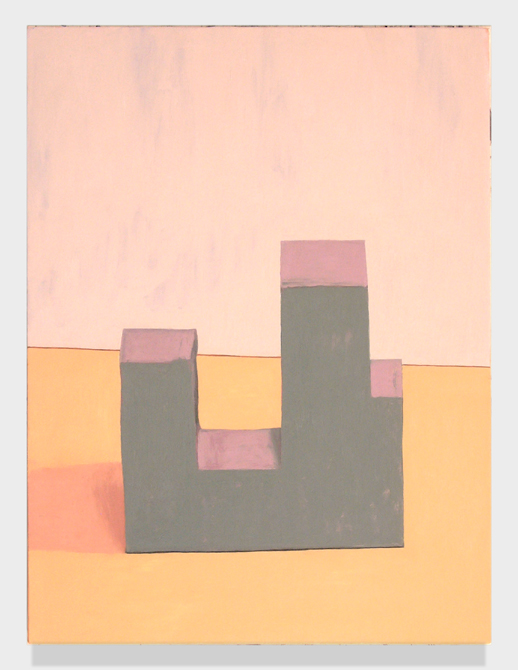
First, we are each going to make a simple “abstract object”
sculpture. Choose a basic, easily workable material (cardboard, wood,
construction paper, etc). Use your chosen material to make a small (between
8”-18” or so) three-dimensional geometric form. This form should not represent
a recognizable object, it should simply be a shape that is three dimensional
and geometric. It can be as basic as a cube or a pyramid, or it can be
something slightly more complex. Once you have completed the form, you are
going to paint it (I recommend acrylic, or you can gesso it and paint it with
oil). Paint each side of the object differently. One may be a plain white, one
may have stripes, one may be a bright green with dots, etc. Never repeat the
same side twice. Try to make the colors work together. Make something that is
aesthetically appealing.
Second, we are going to bring our new abstract object to class and
make an observational still-life painting of it. You will set your painting up
on a surface, light it, choose a background, and then paint it as faithfully as
you can using your observational painting skills. We may choose to cluster
several of the objects together. Your painting should be somewhere between 16 x
20” and 18 x 24”. You can work indirectly with an underpainting, or go straight
into working with color. We will spend this time trying to make the most
accurate painting we can and shaking some of the rust off for those of us who
haven’t painted in a while.
The final result
will be a representational painting of an abstract object. Does that make it an
abstract painting as well? Maybe the line between the two is less clear than
one might think. This project will hopefully get us thinking about these
questions and allow us to move towards abstraction, but in a way that is
connected to how we’ve worked in the past.
Project Schedule
Thursday, August 25: Introduction to Project
Homework:
Make your “abstract object” sculpture over the weekend. It should be completely
finished and ready to be the subject of our painting by Tuesday.
Tuesday, August 30: We will set up our
abstract objects and begin our paintings of them.
Thursday, Sept. 1: We will continue work
on them.
Homework:
Finish your abstract object painting.
Tuesday, Sept. 6: We will critique the
paintings and I will introduce Project 2.
Images Below: Victor Pesce (studio), Victor Pesce, Jessica Stockholder, Andrew Holmquist, Richard Tuttle



Tuesday, April 26, 2016
All Classes - FINALS - Times/Folios
Hi All,
Below is all Finals information. Let me know if you have questions. Cheers, John
Drawing 3: Final Critique, 8am, Thursday, May 5
Final Folio:
3.1 Large Scale Figure Study (in-class)
3.2 Multiple Figures in Interior/Exterior Space (homework)
Drawing 2: Final Critique, 12:30pm, Thursday, May 5
Final Folio:
3.1 Landscape Drawing (in-class, at farm complex)
3.2 Open Homework Drawing
Beginning Painting: Final Folio due in cubby by noon, May 10
Final Folio:
3.1 Landscape
(in-class at farm complex, two small paintings or one medium/large painting)
3.2 Open Homework Painting (18 x 24" or larger)
You can pick up all paintings in your cubby after 3pm on May 12. At that time, please retrieve all materials and clean out your cubby.
Below is all Finals information. Let me know if you have questions. Cheers, John
Drawing 3: Final Critique, 8am, Thursday, May 5
Final Folio:
3.1 Large Scale Figure Study (in-class)
3.2 Multiple Figures in Interior/Exterior Space (homework)
Drawing 2: Final Critique, 12:30pm, Thursday, May 5
Final Folio:
3.1 Landscape Drawing (in-class, at farm complex)
3.2 Open Homework Drawing
Beginning Painting: Final Folio due in cubby by noon, May 10
Final Folio:
3.1 Landscape
(in-class at farm complex, two small paintings or one medium/large painting)
3.2 Open Homework Painting (18 x 24" or larger)
You can pick up all paintings in your cubby after 3pm on May 12. At that time, please retrieve all materials and clean out your cubby.
Thursday, April 7, 2016
All Classes - Next Week

Students,
As you know, I will be out of town next week for an exhibition. Your assignments are all written on the dry erase board in the room (image above), but I also wanted to include directions here:
Drawing 3:
1) Make progress on your 2.5 Figure in Interior Space homework assignment. It will be due on Thursday, April 21 along with your completed Folio #2.
2) Sketchbook #7: Recreate the drawings of the foot from the Bridgman handout. Due Tuesday, April 19.
Drawing 3 Folio #2 (Due Thurs, April 21):
2.1 Straight Line Construction (Two 1-day drawings)
2.2 Movement Drawing (craft paper)
2.3 Layered Drawing (Arches)
2.4 Space/Ladder Drawing (materials open)
2.5 HW: Figure in Interior
2.6 Multi-Media Drawing
2.7 Five Best Gestures
We will put in one more session on 2.6 on Tuesday, Apr 19, then the folio is due the following class (Thurs, Apr 21).
Drawing 2:
1) Make continued progress on 2.4 Self-Portrait homework assignment. Remember, this should be drawn from life and observed by looking at a mirror while drawing.
2) Begin and make significant progress on 2.6 Abstract Repetition/Mark-making Assignment (described in previous post)
Bring both in on Tuesday, Apr 19. We will discuss the works in progress and continue working on 2.6 in class. Folio #2 is due the following class:
Drawing 2 Folio #2 (Due Thurs, April 21):
2.1 Value Skull Drawing
2.2 Long Value Head (Joe)
2.3 Value Head / Low Light (Joe)
2.4 HW: Self-Portrait
2.5 Tactile / Blind Self-Portrait
2.6 Abstract Repetition/Mark-Making Assignment
2.7 Three Best Gestures
Beginning Painting:
Make significant progress on your 2.3 Self-Portrait homework assignment. You will bring this work in on Tuesday, April 19, and we will discuss your work in progress. Remember, this can be done using a direct or indirect method - your choice. It should however be observed by looking at a mirror and painted from life. We will continue work on our head study of Erica that Tuesday as well.
1043 - Drawing 2 - Abstract Repetition & Mark-Making Assignment
Drawing 2 – Norris
Abstract Repetition & Mark-Making
Assignment
Materials:
Drawing Utensil:
You decide, anything except the
utensils we use in class (charcoal, graphite, etc). It could be ballpoint pen,
sharpie, chalk, stamps, stickers, collage materials, etc.
Paper: One sheet
of 22 x 30” Arches Stonehenge or Arches Cover paper. You can purchase
individual sheets at the bookstore. Tape off a carefully measured, one-inch
border before you begin.
Objective:
In our early
drawing classes, we typically use marks to build an image of a real-life
subject we are trying to recreate on the picture plane. The marks might be
expressive and varied, but they ultimately exist in order to achieve an
illusion of reality, translated from three dimensions down to two. For this
assignment, we are going to allow the marks to take the spotlight and be the
actual subject of the drawing. We will not be creating an image based on
observing the world around us, we will be making work that is more abstract in
nature and defined by a process driven by mark-making, repetition, and
intuition.
Process:
1) Choose a single mark that will be repeated
over and over again throughout the drawing. Choose your mark carefully. It
should be a mark that is important, compelling, or confounding to you. It will
be repeated literally hundreds (if not thousands) of times, so it should be
something that will remain interesting to you over time.
2) The mark can be varied in terms of size,
color, material, etc. or it can remain exactly the same throughout the piece. However,
the largest version of the mark should be no more than one square inch.
3) The definition of “mark” is very broad
here. It might not be made using a traditional drawing method. It may even be a
collage element that is adhered to the paper. Or perhaps it will be a stencil
or a stamp. Be creative. Try to come up with something nobody else will have
imagined.
4) You may wish to create a grid, plan, or
specific method with which to repeat your mark in order to establish a particular
layout or composition; or you may simply repeat the mark in a more intuitive
manner, letting each one tell you where to go next.
5) These marks are not coming together to
create an image of a subject; the marks themselves are the subject.
6) Even though we are not seeking to create
an image, the piece should still feel ambitious, well-crafted, and considered.
Try to think of an element that will unify the piece: a consistent texture or
pattern, layers that create a fade or movement, alternating colors or other
variations that create a consistent composition or design, or simply repetition
that is so exact that it gives the work substance and a sense of craft.
Artists we looked at in reference to this assignment:

Ignacio Uriarte

Agnes Martin

Yayoi Kusama

Tauba Auerbach

El Anatsui
Subscribe to:
Posts (Atom)